Who else is selling on your Amazon listings,
and what changed since yesterday
Unauthorized sellers landing on your listings, prices cut under yours, the Buy Box changing hands over the weekend. It happens on the products you never have time to open, and that is where you find out last.
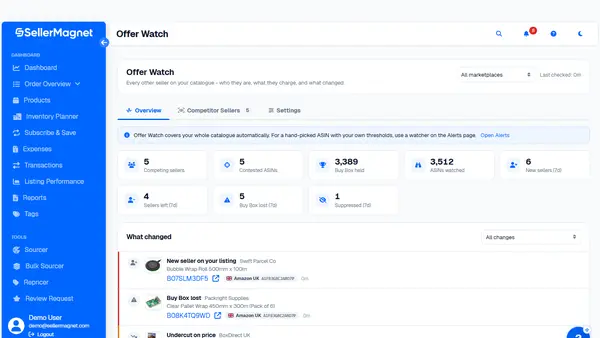
What Offer Watch is. An automatic check across your whole active catalogue, in every country you sell in, once a day. You do not choose the products: we take them from your account and keep them up to date ourselves. When something changes, we tell you. When nothing changes, we do not write.
Official Amazon connection, revocable whenever you want. Nothing to install.
Nobody keeps a record of the offers, so there is nothing to compare
Who sells on your listing is public information: you just open the page. The problem is that the page only tells you the moment you are looking at it. Who was there yesterday, at what price, who held the Buy Box last week: nobody knows, because nobody writes it down.
- You find out from the numbers. Sales drop, and only then do you go and look at who is on the listing.
- You always check the same three products. Nobody opens the rest.
- Even when you look, you have no before. You see three sellers, but you do not know whether yesterday there were two.
Offer Watch does one thing, and does it every day: it looks, it remembers, and it compares.
Only what changed, ordered by what it costs you
Every entry says what happened, on which product, in which country, and what it means for your money.
- Someone arrived on your listing. Seller name, Merchant ID, the price they came in at, and whether they are FBA or FBM. If your authorized distributors are on that listing, you never hear about them: you mark them once and they stop ringing.
- The Buy Box changed hands. Lost, won back, or suppressed for everyone. When you lose it we tell you who took it and by how much they were under you.
- Someone undercut you. With a threshold you set, because one cent is not news and should not wake you up.
- A seller left. As useful as an arrival: it is the moment the Buy Box becomes winnable again.
- The listing has a problem. Suppressed, not buyable, or edited. These come from Amazon itself, so we pass them straight through.
- Your rating dropped. Average and review count checked every day, with a threshold below which we leave you alone.
An alert that gets it wrong is worse than no alert
The hard part of these tools is not noticing things. It is staying quiet when nothing happened. After three false alarms nobody opens the emails any more. Here are the five rules we hold ourselves to.
- A seller missing from one check has not left. The offer list is a window: someone can slip below the edge and still be there. Before we tell you they are gone, we wait to not see them twice in a row.
- On day one you get nothing. We build the baseline first, then we start comparing. Otherwise your first email would list every competitor who had been there for months.
- Your own resellers are not intruders. You mark them once, with their Merchant ID, and they stop showing up as arrivals.
- We never tell you that you left your own listing. It sounds obvious, and it is the classic mistake of anyone comparing seller lists without knowing which one is you.
- Undercutting has a threshold. You choose it, and below it we stay quiet.
An email you can read in thirty seconds, even when a lot happened
It is the part we worked on hardest, because it is the only one the customer sees every day.
- One intruder is one line. Someone who arrives underpriced and takes your Buy Box produces three separate things. You read one: who they are, at what price, how far under you, and whether they hold the Buy Box.
- A seller who lands on twelve of your products is one line. Not twelve. Arrived on twelve listings, undercutting you on five, holding the Buy Box on three, with the first products linked.
- A hundred undercuts are one section. With the rows that cost you most at the top and the rest one click away in the dashboard.
- Things that undid themselves sit at the bottom. A seller who came and went, a Buy Box lost and won back: one grey line, not two opposite alarms.
- When a lot happened, it changes shape. It becomes a summary: how many listings are under attack, the net between Buy Boxes lost and regained, the deepest cut with the name of whoever made it, and the five things to look at today.
- One language per email, yours. Eight languages, and never an email half in English.
- Names, not codes. Sellers have names, countries have flags, and an undercut names their price and yours.
The list of everyone competing with you, and how much they weigh
Not a list of events, but a picture of who you are up against. For every seller: name, Merchant ID, how many of your listings they are on, how many they hold the Buy Box on, how many countries, FBA or FBM, their feedback, their price, and how long we have been seeing them.
- Who holds one of your Buy Boxes. The ones costing you money right now.
- Who is expanding. Who has taken new listings of yours since the watch began: the sign that someone is moving from occasional to systematic.
- Amazon Retail. Recognised separately, because it is not a fight you pick the same way.
- Who left. The history stays, so when they come back you already know them.
Exports to CSV and Excel, by seller or by seller and product, ready to drop into a report.
You decide what wakes you up and what can wait
- What we check is on or off. We look once a day, so it lands in the daily summary. No promise we cannot keep.
- What Amazon pushes to us is your call. Straight away, hourly, daily, or never.
- A cap on immediate alerts. Because one bad day should not turn into forty emails.
- The summary at the hour you choose. Every day, or once a week.
- Extra recipients. Your partner, your account manager, whoever runs the marketplaces.
Everything you sell, and only that
- We take the catalogue from your account. And keep it in step ourselves: a new product joins without you doing anything.
- We do not check inactive listings. They do not answer. There is no sense in charging you to look at a page that is no longer there.
- One pass a day across everything. The tighter cadences, every eight hours and every hour, are there when you need them.
- Every country and every account you connect. In one panel.
You pay for what we watch
One ASIN on one marketplace, at the frequency you choose. The same product sold in five countries is five real listings, with five different sets of competitors and five different Buy Boxes.
The cadences cost differently because checking a listing every hour means reading it twenty four times a day instead of once.
What Offer Watch costs
Automatic sweep of your whole catalogue: hijackers, Buy Box, suppressed listings, undercuts, BSR and reviews.
What you get
- Every pollable ASIN on every connected marketplace, no setup
- Daily, 8-hourly or hourly checks
- Email and webhook delivery
What if I want to follow a product I do not sell?
Offer Watch looks at your catalogue and finds it by itself. If you want to keep an eye on a competitor's ASIN, with your own thresholds, that is the other module.
See Competitor TrackerWho keeps it on, and why
Brands and private label
The problem is unauthorized sellers. You find them without looking, and your real distributors make no noise.
Resellers with a wide catalogue
A wide catalogue is made of listings nobody ever opens. Here they open themselves, every day.
Agencies and multiple accounts
Every client in one panel, and a report you can export and send without rewriting it.
Frequently asked questions
Do I have to choose which products to watch?
No, and that is the point of it. We take the catalogue from your account and keep it up to date ourselves. If you list a new product tomorrow, it joins without you doing anything.
How often do you really check?
Once a day across the whole catalogue. If you need it more often you can choose every eight hours or every hour. Anything Amazon reports to us, such as a suppressed listing, we pass on as soon as we receive it.
Why not in real time?
Because every check is a real read. Anyone promising real time across a whole catalogue is either looking far less often than they say, or charging far more than it looks. We would rather tell you the exact cadence and let you choose how fast you want to be.
What do I get on day one?
No alarms. Day one builds the baseline, so you do not get an alert for every competitor who was already there. From the next day you only get the differences.
Will my authorized resellers fill my inbox?
No. You mark them once with their Merchant ID and they stop showing up as arrivals. If you mistype it, we tell you before you save.
Does it work across countries and multiple Amazon accounts?
Yes, all the ones you connect. The same product in different countries is followed separately, because those are different listings with different competitors.
Can I take the data out?
Yes. Competitors and events export to CSV and Excel, with the columns you choose.
Can I try it before paying?
Yes, during the trial, on the daily check and up to a thousand slots: a thousand ASINs on one marketplace, or two hundred across five. If your catalogue is bigger, we will set up a trial that fits.
What happens if my catalogue grows past the size I picked?
Nothing switches off. The excess keeps being checked once a day and we tell you which size fits, so you can decide calmly.
Connect it once,
then you know the same day
The next seller landing on your listing lands there either way. The difference is whether you find out tomorrow morning or three weeks from now, when you look at sales and they do not add up.
Official Amazon connection, with only the permissions needed. Revoke it whenever you want.